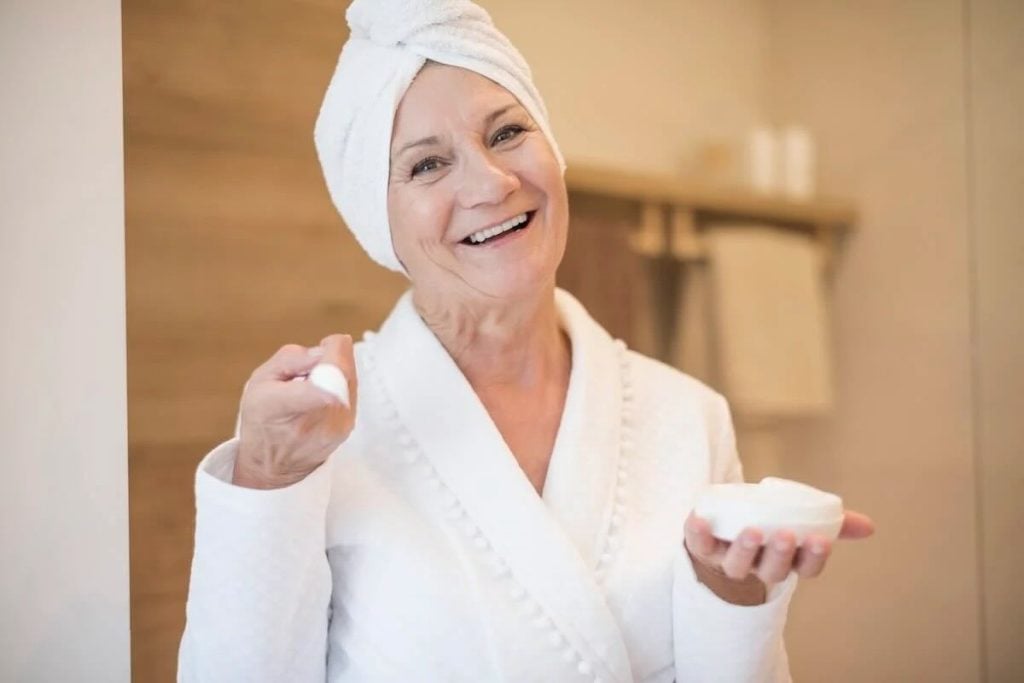
The bathroom was warm and misty, yet Jeanne, 72, stood motionless in her robe. One hand rested on the towel bar, the other gripped the sink.
Her granddaughter had just asked, half laughing, “Mamie, do you really shower every day?” and the question lingered in the air like steam on the mirror.
No one had ever told her that aging skin behaves differently.
That after 65, the old rules no longer apply.
She grew up with the belief that true cleanliness meant a daily scrub. Her mother had insisted on it, even when hot water was a luxury and Sunday meant the “big wash.”
But now her legs itched constantly.
Her back felt thin and dry like paper.
And the more she washed, the worse it became.
There is a shower rhythm that protects health after 65 and it’s not the one most people learned.
After 65, your skin plays by new rules
Talk to people over 65 about their shower habits and you’ll often hear two extremes.
Some continue their lifelong daily shower almost out of duty. Others quietly drift into once-a-week routines, worn down by fatigue, fear of slipping, or simple overwhelm.
Both groups carry a kind of guilt.
Daily showerers notice their skin cracking and flaking.
Those who wash less often worry about odor, infections, or what a doctor might think.
Between these two lies a gentler, healthier middle path one that respects aging skin, preserves comfort, and still allows you to feel fresh.
André, 79, a retired electrician, used to begin every morning with a long, very hot shower. Soap from neck to toe, vigorous scrubbing with a sponge — his “wake-up ritual.”
Last winter his dermatologist examined his arms and shins: red, scaly, almost transparent.
She didn’t start with creams. She asked, “How often do you shower?”
When he proudly answered, “Every day, of course,” she shook her head.
Too often. Too hot. Too harsh.
Within a month of changing his routine, the itching stopped. He slept through the night without scratching.
After 65, the skin produces far less oil. Its protective barrier becomes thinner, and moisture escapes more easily.
Long, hot showers remove the small amount of sebum that remains. Repeated day after day, this leads to tiny cracks, inflammation, and sometimes eczema or infection.
But going an entire week without washing allows sweat, bacteria, and dead skin to build up especially in warm areas like armpits, the groin, under the breasts, and between the toes.
The real question is no longer “Should you shower every day?”
It becomes “How do you stay clean without harming your skin?”
The healthiest shower rhythm after 65
Dermatologists who work with older adults often give the same guidance: for most healthy people over 65, a full-body shower two to three times a week is enough.
On the other days, a quick wash of key areas face, armpits, groin, feet, and skin folds keeps the body fresh.
It’s a shift from “all or nothing” to a smarter rotation.
Short showers. Lukewarm water.
Soap only where it’s truly needed.
The aim is simple: clean the places where bacteria gather and protect the areas where skin is fragile.
Mobility and energy also matter. Stepping into a bathtub at 78 with aching knees is not the same as at 30.
Many older adults quietly delay showers because the effort feels overwhelming and they fear being judged.
Yet a careful wash at the sink can be highly effective.
Caregivers often recommend two or three weekly showers combined with daily gentle “toilette au lavabo.”
Residents who follow this routine frequently have fewer skin problems than those who insist on long, hot daily showers.
Frequency alone isn’t the key method matters just as much.
From a biological point of view, the ideal rhythm is determined by balance: removing dirt while keeping the skin barrier intact.
A calm, retired lifestyle simply doesn’t produce the same level of sweat and oil as younger, more active years.
Flexibility becomes essential.
Two or three full showers, with light daily refreshing in between, adjusted to your body and your comfort.
How to wash “less often” without feeling less clean
Showering less frequently doesn’t mean feeling unclean. It means breaking hygiene into smaller, easier steps.
In the morning, wash your face and brush your teeth, then spend a couple of minutes on the priority zones armpits, groin, feet, and skin folds.
In the evening, a quick wipe with a damp washcloth where sweat collects can be enough.
Think of daily “refreshing” and twice-weekly “deep cleaning.”
On shower days, use lukewarm water.
Soap only where necessary.
Pat the skin dry gently — never rub.
Many older adults fall into two traps: scrubbing as if they were still 25, or giving up because everything feels exhausting.
Both lead to the same discomfort.
If you tend to scrub too hard, start by removing the rough sponge. Use your hands and a mild cleanser for sensitive or mature skin.
If fear of falling is the obstacle, practical changes a shower chair, a non-slip mat, a handheld shower can transform the experience into a safe, seated routine.
For caregivers, the words matter too.
“How can we make this more comfortable?” opens far more doors than “You need to wash more often.”
Hygiene after 65, between health, dignity, and real life
Once the topic is discussed openly, stories emerge.
The son who discovers his mother is afraid of the bathtub.
The woman whose constant itching disappeared when she stopped showering every day.
Some feel best with two weekly showers and careful daily refreshing.
Others. more active or living in warm climates may need three or four.
Those living with incontinence require a different rhythm, focused on gentle local washing.
Upbringing and pride play a role too. For a generation raised on “Cleanliness is next to godliness,” changing habits can feel like losing a part of identity.
But the truth is simple: the body at 65 does not have the same needs as at 30.
Adjusting your routine is not neglect, it is respect for the skin that has carried you this far.
The conversation is only beginning in families, in doctors’ offices, between friends.
Somewhere between the daily shower and the weekly one, each person can find their own rhythm. one that keeps them healthy, comfortable, and fully themselves.