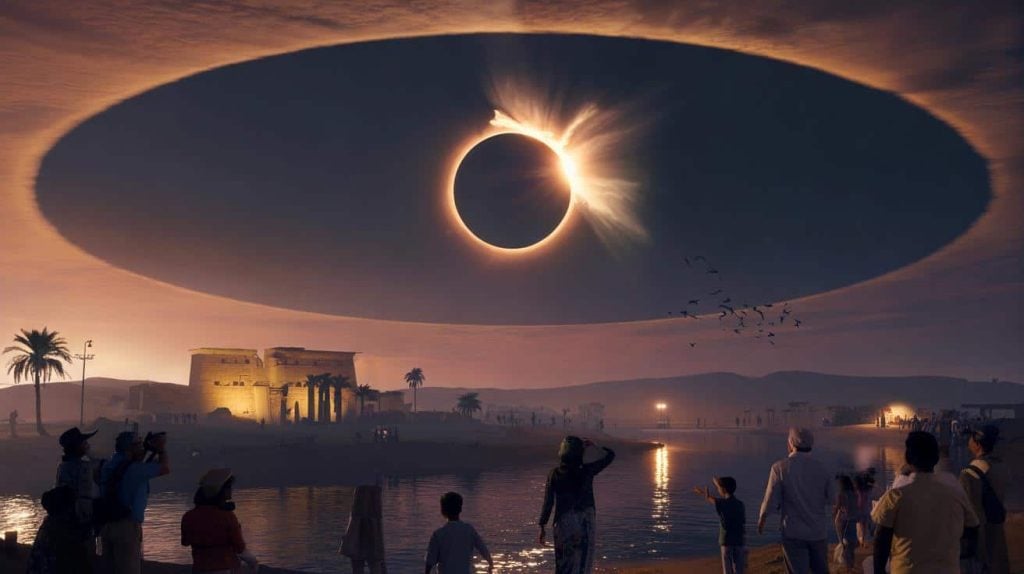
On August 2, 2027, astronomers confirm that the longest total solar eclipse of the century will sweep across parts of Europe, North Africa, and the Middle East, turning day to night for over six unforgettable minutes. Experts call it a “once-in-a-lifetime” cosmic alignment—and millions are already preparing to witness it.
The Day the Sun Will Vanish
The 2027 eclipse will last up to 6 minutes 23 seconds at peak totality—more than double the duration of most modern eclipses. For a narrow band of the planet, daylight will drain away as if a cosmic dimmer switch were slowly turning down the sky. Streetlights may flicker to life, stars could appear, and the Sun’s ghostly corona will shimmer like a white crown of fire.
For observers across southern Spain, Morocco, Algeria, Tunisia, Libya, and Egypt, this event will be nothing short of breathtaking. Cities like Luxor and Cairo will experience one of the longest total phases ever recorded in modern times. Imagine the ancient temples of Egypt plunged into twilight as the Sun disappears—an image worthy of both science and mythology.
Why This Eclipse Is So Rare
Every total solar eclipse is special, but this one stands apart. The Moon will be unusually close to Earth—at what astronomers call perigee—making its dark disk appear slightly larger. Meanwhile, the Earth will be at aphelion, its farthest point from the Sun, causing the solar disk to look smaller. The result? A near-perfect overlap that extends total darkness longer than any other eclipse this century.
The last eclipse to exceed six minutes occurred in 2009 over the Pacific. The next won’t happen until the 22nd century. For anyone lucky enough to be under the path of totality, this will be the eclipse people talk about for generations.
How to Experience the 2027 Eclipse
You don’t need a telescope or a PhD in astrophysics to enjoy the show—just the right location and a little planning. The path of totality begins in the Atlantic Ocean, passes over southern Spain and the Mediterranean, and then stretches across the deserts of North Africa before reaching the Middle East and the Arabian Peninsula.
Experts recommend picking your destination early. Andalusia in Spain and Luxor in Egypt are expected to be major viewing hotspots. To avoid crowds, consider smaller towns just outside those regions. The eclipse doesn’t care whether you’re on a beach or a backroad—the view is the same.
Arrive at least one or two days before the event. Travel disruptions, weather changes, and overbooked hotels are common during major eclipses. Many seasoned eclipse-chasers even prepare a “Plan B” location within driving distance in case of cloudy skies.
Preparing for the Big Moment
Safety first. Looking directly at the Sun without proper protection can cause permanent eye damage. Use certified solar eclipse glasses or a pinhole projector to view the partial phases safely. During the few minutes of totality, when the Sun is completely covered, it’s safe to look with the naked eye—but only then.
Don’t let gadgets steal the moment. Many people get so focused on filming that they forget to look up. Veteran observers suggest taking a few quick photos before totality, then simply watching as day turns to night. The memory will last longer than any video clip.
“The first time I saw totality, I forgot every camera setting and checklist,” recalls a long-time eclipse chaser. “I just stood there, in silence. It was the most humbling thing I’ve ever seen.”
What Happens During a Total Solar Eclipse?
Even if you’ve seen pictures, nothing compares to experiencing it in person. As the Moon covers the Sun, the light changes quality—it becomes metallic, surreal, like standing inside a painting. Birds stop singing. The wind may shift. People gasp or cry quietly. It’s a moment when nature itself seems to pause.
During those six minutes, the solar corona—the Sun’s outer atmosphere—unfolds in soft, pearly tendrils visible only during totality. Bright planets like Venus or Jupiter might appear. The horizon glows with a 360-degree sunset effect. Then, suddenly, the diamond-ring effect flashes—and daylight returns.
The Science Behind the Spectacle
For scientists, the 2027 eclipse is more than a show; it’s an opportunity. Researchers will study the Sun’s corona, track solar winds, and analyze the effects of sudden darkness on weather and wildlife. NASA and the European Space Agency are expected to deploy aircraft, balloons, and ground-based observatories to capture high-resolution data.
“Every total eclipse helps us understand our Sun better,” says Dr. Leila Haddad, solar physicist at the University of Paris. “It’s like peeling back a layer of light that normally blinds us. These six minutes could reveal secrets about the Sun’s magnetic field and energy cycles.”
Travel, Tourism, and Local Impact
Tourism agencies in Spain, Morocco, and Egypt are already preparing for a surge in visitors. Hotels along the path of totality expect to sell out months—if not years—in advance. Some regions are even considering special “eclipse holidays” to accommodate travelers and scientists.
Local economies could see short-term booms similar to those in the United States during the 2017 eclipse, when small towns saw visitor numbers multiply tenfold. Restaurants, transportation companies, and local guides all stand to benefit from the influx of curious skywatchers.
How Eclipses Unite Us
Throughout history, eclipses have inspired awe and fear in equal measure. Ancient Egyptians saw them as battles between gods. Chinese astronomers recorded them more than 4,000 years ago. Today, we understand the physics, but the feeling remains the same—a shared wonder at our place in the cosmos.
When the shadow passes, there are no borders, no politics—only people looking up together. It’s a rare event that connects humanity in silence and wonder, if only for a few minutes.
Final Thoughts: A Reminder of Our Fragile Perspective
The 2027 solar eclipse will be more than an astronomical milestone; it will be a moment to step outside the rush of daily life. In a world full of screens and noise, this sudden, natural darkness is a quiet reminder that we’re part of something vast and intricate.
So mark your calendar—August 2, 2027. Find a place under the Moon’s path. Bring your glasses, a sense of curiosity, and maybe someone you love. When daylight fades and the stars emerge in the middle of the afternoon, you’ll know you’ve witnessed one of the most extraordinary sights of our lifetime.