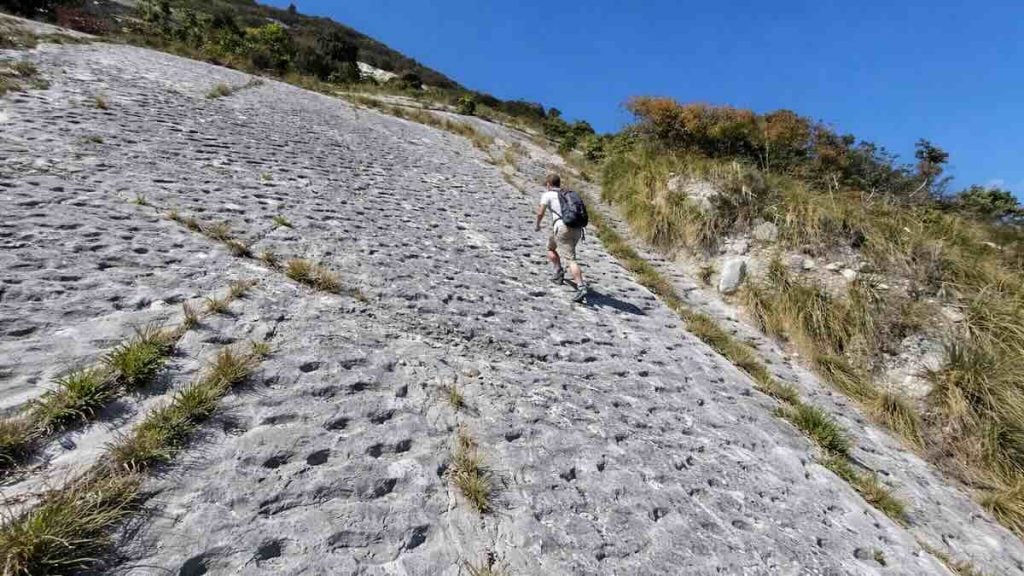
High above the Adriatic Sea, carved into a towering rock face, lies what may be one of the most dramatic moments ever preserved from Earth’s deep past. Hundreds of strange grooves etched into the limestone of Monte Cònero appear to record a frantic underwater escape, as ancient sea turtles bolted from a powerful earthquake nearly 80 million years ago.
The discovery was made by rock climbers who noticed the unusual markings while scaling the cliffs of Cònero Regional Park in Italy. The shapes looked eerily familiar. Earlier that same year, similar grooves found nearby were linked to marine reptiles pushing their flippers into the seabed. Realizing the potential significance, the climbers contacted geologist Paolo Sandroni, setting off a scientific investigation into a long-forgotten catastrophe.
A Disaster Preserved Beneath the Sea
Researchers soon confirmed that the rock layer holding the tracks was once a deep seafloor, hundreds of meters below the ocean surface during the Late Cretaceous period. Today it forms part of a mountain — a result of powerful tectonic forces that folded and lifted the seabed over millions of years.
By analyzing rock samples taken just above the grooves and mapping the site with drone imagery, scientists uncovered a crucial clue: the tracks were buried almost instantly by an underwater avalanche of mud. That sudden collapse, they say, was triggered by an earthquake.
Normally, any marks left on the seafloor would vanish quickly, erased by currents and bottom-dwelling organisms. But in this case, the earthquake struck moments after the animals passed through, sealing their movements in stone.
A Sudden Panic in the Ancient Ocean
At the time, only large marine reptiles could have produced tracks of this size. While plesiosaurs and mosasaurs lived in the same era, researchers believe sea turtles are the most likely culprits.
If ancient turtles behaved anything like some modern species, they may have gathered in groups while feeding or migrating. When the earthquake hit, chaos followed. Some turtles appear to have surged upward toward open water, while others scrambled across the seafloor — just as collapsing sediment chased them away from danger.
The result is a rare fossil snapshot: not of bones or shells, but of fear, movement, and survival.
Scientists Still Debating the Evidence
Not everyone is convinced. Some paleontologists argue the track patterns don’t perfectly match how modern sea turtles swim. The grooves suggest both front flippers struck the seafloor at the same time. an unusual motion for animals known for smooth, flying-like swimming.
Still, researchers involved in the study stress that the geological evidence is undeniable. The earthquake happened. The underwater avalanche followed. And something large fled across the seabed just moments before disaster struck.
Now, scientists hope the site will draw more fossil experts, who may finally confirm what kind of animal left behind this extraordinary record and reveal more about how life responded when the ancient Earth suddenly turned violent.